
As the heavy snow from a Canadian winter melts and the intense spring rains arrive, your basement's defense capabilities will be tested to the limit. For many homeowners, a sump pump is viewed as the magic bullet—the only thing standing between a dry house and a catastrophic flooded basement. But a sump pump alone is rarely enough.
The Role of Interior Drainage (Weeping Tile)
To understand the system, we first need to look at how water gets to the pump. An interior drainage system (often referred to as an interior weeping tile system) is a network of perforated PVC pipes installed in a trench dug beneath your basement's concrete floor slab, right alongside the foundation footings.
The job of this drainage pipe is passive collection. Because it sits lower than the basement floor, it gives the highly pressurized water in the surrounding wet clay soil a "path of least resistance." Instead of pushing upward through the cracks in your concrete floor or seeping through the wall joints, the water simply falls into the perforated pipe and is continually sloped toward a central collection pit.
The Role of the Sump Pump
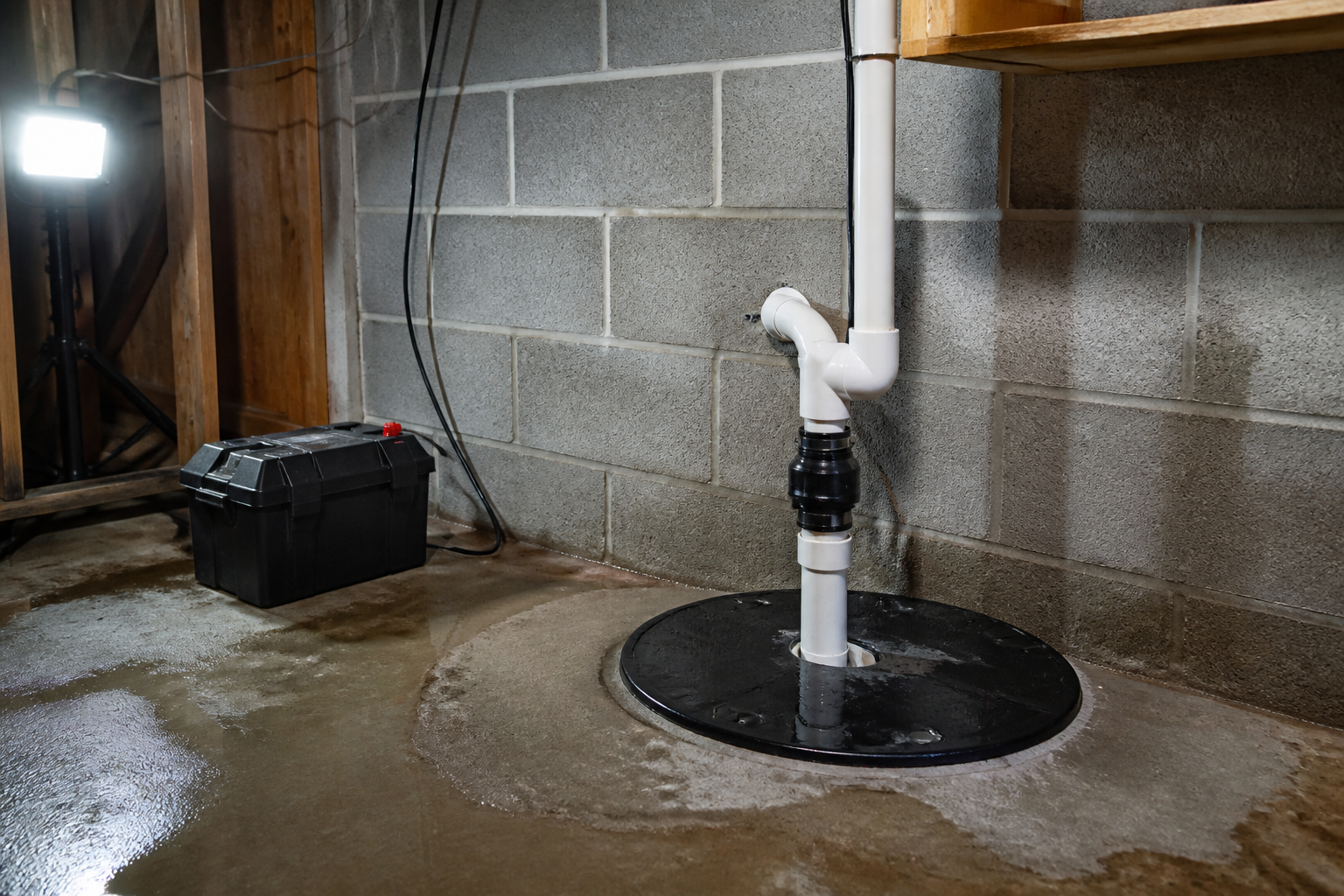
The sump pit is essentially a heavy-duty plastic barrel buried flush with the basement floor. This is where the weeping tile pipes empty the collected groundwater.
The sump pump sits at the bottom of this pit. As the weeping tiles pour water in and the water level rises, an automatic mechanical float switch is triggered. The pump turns on, and an impeller violently forces the water up through a vertical discharge pipe, pushing it outside the house far away from the foundation.
Why You Absolutely Need Both
A common mistake homeowners make is assuming adding a sump pump to a damp basement will solve all their moisture problems. A sump pump without a drainage system is essentially useless. It can only draw water from the immediate 3-foot radius around the pit. If water is leaking through a wall 30 feet away, the sump pump cannot act as a vacuum to pull that water across the basement; the floor will simply flood.
Conversely, a drainage system without a functioning sump pump is a disaster waiting to happen. If the weeping tiles successfully collect thousands of gallons of water but the sump pump fails to eject it, the pit will quickly overfill, and the highly pressurized water will geyser out of the pit, flooding the basement floor.
The Ultimate Defense System
Because these systems rely on mechanics and electricity, failure is always a possibility during a severe thunderstorm when the power goes out. To achieve true peace of mind, a professional system must include redundancies.
- Primary Pump: A heavy-duty, 1/3 or 1/2 horsepower cast-iron pump capable of moving 3,000+ gallons per hour.
- Check Valve: A one-way valve on the discharge pipe ensuring water pushed up the pipe doesn't fall backward into the pit when the pump shuts off.
- Battery Backup System: A dedicated, 12-volt DC marine battery attached to a secondary, independent pump sitting directly above the primary pump. If the power fails, the battery backup automatically takes over.
Is Your System Ready for Spring?
Sump pumps have a finite mechanical lifespan of roughly 7 to 10 years. If your pump is old, making grinding noises, or lacks a battery backup system, call Foundations First at (905) 929-0441 to have a professional-grade Triple-Safe system installed today.